
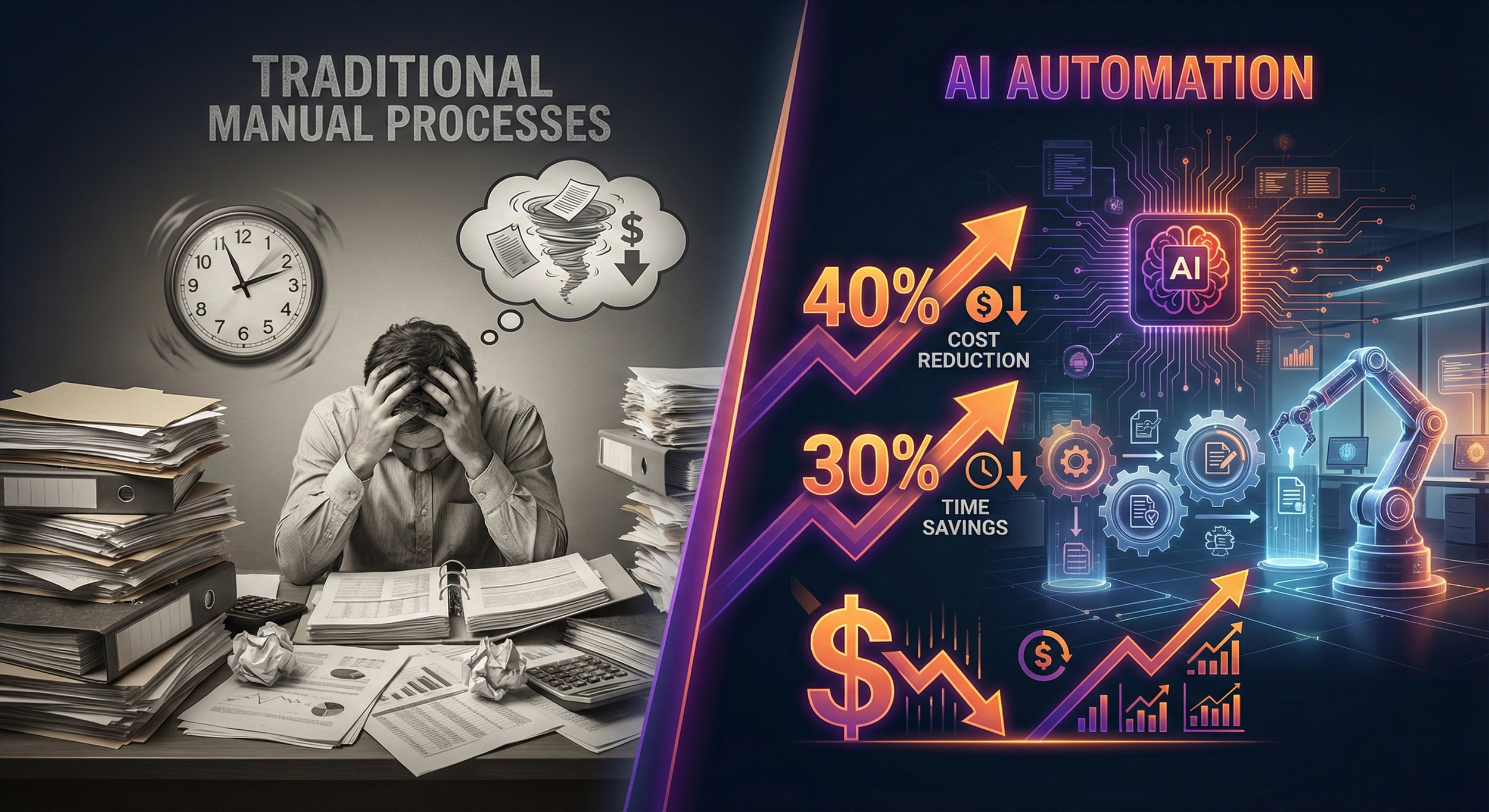
In today's competitive business landscape, efficiency isn't just a buzzword—it's survival. While many companies are still exploring AI as a "nice-to-have," forward-thinking organizations are already seeing 30-40% reductions in operational costs through strategic AI implementation.
The Real Cost of Manual Processes
Think about your daily operations: data entry, customer service inquiries, invoice processing, report generation, appointment scheduling. These tasks consume thousands of employee hours annually. What if you could automate 80% of them while actually improving accuracy?
The average business loses 20-30% of annual revenue to inefficiencies in manual processes. That's not just time—it's money walking out the door every single day.
Where AI Delivers Immediate ROI
1. Customer Service Automation
AI-powered chatbots and virtual assistants can handle up to 80% of routine customer inquiries 24/7. This doesn't mean replacing your team—it means freeing them to handle complex issues that require human empathy and problem-solving.
Cost Impact: Companies typically see 50-70% reduction in customer service operational costs within the first year.
2. Data Processing & Analysis
Manual data entry and processing are not only time-consuming but prone to human error. AI systems can process thousands of documents in minutes, extracting and organizing data with 99%+ accuracy.
Cost Impact: Reduce data processing time by 90% while eliminating costly errors that can run into thousands of dollars per incident.
3. Predictive Analytics
Stop making decisions based on gut feelings. AI analyzes historical data, market trends, and customer behavior to predict inventory needs, maintenance requirements, and sales patterns with remarkable accuracy.
Cost Impact: Reduce waste by 25-35% and optimize inventory investment, freeing up capital for growth initiatives.
4. Workflow Automation
From invoice approvals to employee onboarding, AI can orchestrate complex workflows that currently require multiple touchpoints and manual oversight. Automated workflows reduce bottlenecks, eliminate delays, and ensure consistent process execution.
Cost Impact: Reduce administrative overhead by 40-60%, allowing staff to focus on strategic initiatives rather than routine tasks.
Real-World Example: Small Business Transformation
A mid-sized logistics company implemented AI automation for route optimization, customer communication, and inventory management. Here's what happened after 6 months:
Results After 6 Months:
Getting Started: The Smart Way
The key to successful AI implementation isn't adopting every new tool—it's strategic identification of high-impact opportunities. Not every process benefits equally from automation, and the most successful implementations focus resources where they'll generate the highest returns.
Our Proven 4-Step Framework:
Step 1: Process Audit
We identify your most time-consuming, repetitive, and error-prone processes. Not everything needs automation—we focus on what delivers the highest ROI. This comprehensive audit examines your current workflows, identifies bottlenecks, and calculates the true cost of manual processes.
Step 2: Custom Solution Design
No cookie-cutter approaches. We design AI solutions that integrate seamlessly with your existing systems and workflows. This includes selecting the right technologies, designing integration points, and ensuring compatibility with your current tech stack.
Step 3: Phased Implementation
Start small, prove value, then scale. This minimizes disruption while building internal buy-in and expertise. Early wins demonstrate ROI and build confidence, making larger-scale rollouts smoother and more successful.
Step 4: Continuous Optimization
AI systems learn and improve over time. We monitor performance metrics and continuously refine to maximize your ROI. Regular reviews ensure your automation evolves with your business and continues delivering value.
The Competitive Advantage
Here's the reality: Your competitors are either already implementing AI or planning to. The companies that act now gain years of competitive advantage in efficiency, cost structure, and market responsiveness.
But there's a window. Early adopters in each industry sector gain the most significant advantages. As AI becomes standard practice, the competitive edge diminishes. The question isn't whether to implement AI—it's how quickly you can move to maintain competitive advantage.
Common Concerns Addressed
Will AI replace our employees?
In our experience, AI augments human capabilities rather than replacing them. It eliminates tedious tasks, allowing your team to focus on strategic, creative, and relationship-building work that humans do best. Most successful implementations result in role transformation rather than elimination, with employees moving to higher-value activities.
Is it too expensive for our size?
AI solutions scale to any business size. We've implemented cost-effective automation for companies with 5 employees and enterprise corporations alike. The question isn't whether you can afford it—it's whether you can afford NOT to. With typical 3-month ROI timelines, the investment pays for itself quickly.
What if it doesn't work for our industry?
AI applications are industry-agnostic. From healthcare to manufacturing, retail to professional services, the fundamental principles of automation, prediction, and optimization apply universally. Each industry has unique processes, but the automation principles remain constant.
Take the First Step
The journey to AI transformation begins with a simple conversation. We offer complimentary strategic consultations to help you understand your highest-impact automation opportunities, expected ROI and timeline, total investment required, and success metrics.
No commitment. No pressure. Just clarity on how AI can transform your business operations.
Schedule Free Consultation Explore ServicesReady to Cut Costs While Scaling Efficiency?
Schedule Your Free Strategic Consultation Today
📧 Email: info@okiesolutions.org
📱 Phone: (281) 944-5596
⏱️ Response Time: Within 2 business hours
OkieSolutions - Transforming Ideas into Digital Reality